Tulou is a kind of earthen house, built by the Hakka and Minnan peoples in the mountainous and rural areas of southeastern China, mainly in the province of Fujian. They were mostly built between the 12th and the 20th centuries. Tulou is a powerful, multi-storey home, usually circular in shape, with a very thick, 'almost 6 feet' of mud walls, reinforced with wood, bamboo and stones, with access to the central courtyard through one door only. The result is a well-lit, well-ventilated, windproof and earthquake-proof building that is warm in winter and cool in summer. Tulous usually have only one main gate, guarded by 4–5-inch-thick or 100–130 mm wooden doors reinforced with an outer shell of iron plate. The top level of these earth buildings has gun holes for defensive purposes. In the middle of the stone courtyard is a small building performing ceremonial functions like weddings, funerals, and prayer. The courtyard is surrounded by wooden corridors leading to housing consisting of two or three rooms. The two lowest floors of Tulou are bulky, do not have windows, and are most commonly used as warehouses and granaries, while homes are located above the second floor.

Hekeng Tulou, Fujian. Image credit: Fon Zhou
Tulou are called "small kingdoms" or "small towns" because they fit the whole clan and can house up to 800 people or 80 families each. Tulou first emerged as early as the thirteenth century, But the most complex houses were built in the seventeenth and eighteenth centuries. Tulou design exercises not only residential and defensive functions but also provide harmony and peace of mind thanks to the subordination of the rules of feng shui. In the province of Fujian there are currently 46 Tulou gathered in several groups, of which the largest and best known are Chuxi, Tianluokeng, Hekeng, Gaobei, Dadi, Hongkeng and Yangxian. In 2008 Fujian Tulou, designated as a UNESCO World Heritage site, was a small and specialised subgroup of tulou, known for their unique shape, large scale, and ingenious structure. There are more than 20,000 tulou in southern Fujian, still standing today, ten of which are over 600 years old. The oldest one, “Fu Xing Lou” in Hu Le town, was constructed over 1,200 years ago and is regarded as a “living fossil” of the construction style of central China.

Tulou Entrance. Image credit: christieandsteve

Image credit: yueli717

Tulou courtyard jumble. Image credit: christieandsteve
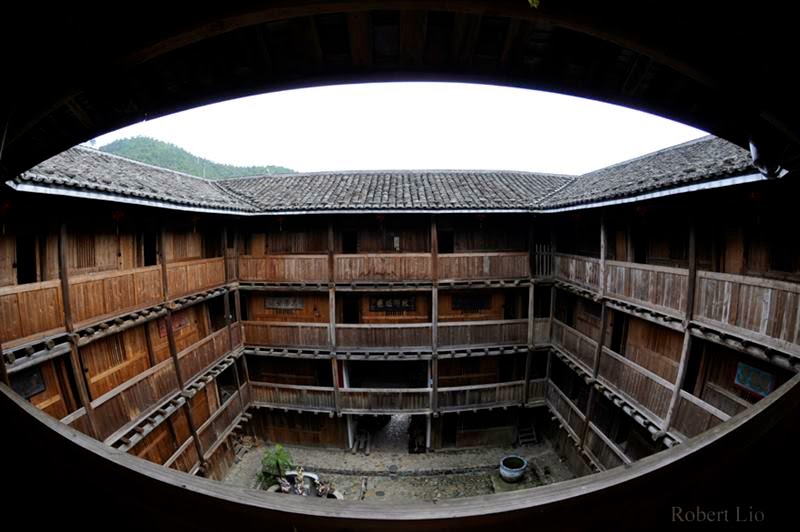
Fujian Tulou, Nanjing District. Image credit: Robert Lio

Yuchang tulou. Image credit: claying

Making an adobe tulou. Image credit: christieandsteve

Tulou and the life surrounding it. Image credit: Squashimono

Yuchang tulou. Image credit: claying

Image credit: Terence Pang

Tulou, Fujian, China. Image credit: Cindy Woo

Necessity is the mother of invention, there are so many innovations borne of this unique style of living. There is so much to be seen that is interesting, yet in my advanced years I've never seen this before.
ReplyDeleteI could spend a year in China.