The Moscow Metro, the world's first by passenger density, carried 9.27 million people in 2011. Moscow Metro stations are also known as the underground palace. It has 196 stations and an underground length of 327.5 kilometres, with 12 lines. All lines are connected by a 20 km long ring line. Lines 2 and 4 cross the Moskva River, and line 1 crosses the Yauza River on a bridge.

Komsomolskaya metro station, Moscow.
The majority of the network is hidden deep below the streets of Moscow – there are a total of 74 deep-level stations, 87 on a shallower level, a further ten on the surface, and four on elevated lines. The reasons for the construction of the deep section station Arbatskaya lie in the onset of the Cold War. They are deep and are designed to hide people in the event of nuclear war.
In a city where the winter climate is more rigorous, it perfectly understands the importance of the metro. But besides its functionality and number of passengers, the subway is known for its ornamentation. The Moscow metro is famous worldwide for the sophisticated decorative aesthetic of many of its stations, a concept related to the idea of Soviet times. Many of the stations were decorated in an allegorical way to celebrate historical dates, dedicated to celebrating countries of the former Soviet Union and epics of the Russian people. It's possible to spend an entire day or more travelling the metro and exploring the vast array of ornate stations, each constructed and decorated in its own unique way.
First Image credit: Garrett Ziegler

Elektrozavodskaya Metro Station, Moscow.
Image credit: Hendrik Terbeck

Maryina Roshcha.
Image credit: jaime.silva

Arbatskaya Metro.
Image credit: jaime.silva

Image credit: Mariusz Kluzniak

Arbatskaya Metro. Image credit: Kwong Yee Cheng

Image credit: Leandro Lucarella
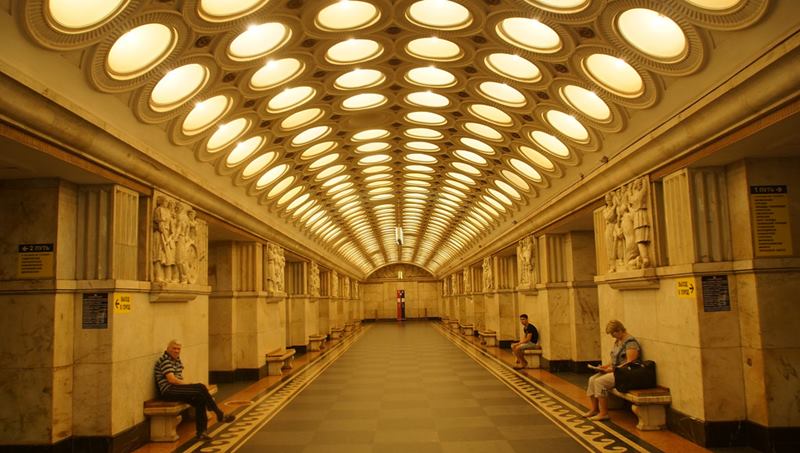
Image credit: Leandro Lucarella

Taganskaya metro station. Image credit: jaime.silva

Park Pobedy Metro Station, Moscow. Image credit: Hendrik Terbeck

Image credit: mariusz kluzniak

Amazing!
ReplyDelete