In the remote wilderness of eastern Siberia, there is a strange geological formation that looks almost like a volcanic crater, but scientists say the story is far more complicated. The Patomskiy Crater, or Patom Crater, is an unusual stone cone that towers over the forested Patom Highlands in the Bodaibinsky District of Irkutsk Oblast of Russia.
 |
| The unusual Patomskiy Crater rises from the forested landscape of eastern Siberia. |
Patom Crater: Inside Siberia’s Mysterious Kolpakov Cone
The formation is located far from large settlements and surrounded by vast Siberian taiga. It has intrigued geologists for decades. Theories involving meteorites, underground gases, volcanic eruptions, and other powerful geological processes have been proposed to explain its unusual shape, its relatively recent geological age, and the uncertainty of its origin.
Where Is the Patomskiy Crater?
The Patomskiy Crater is in the Patom Highlands of eastern Siberia, in the Bodaibinsky District of Irkutsk Oblast. It lies in a remote mountainous landscape covered largely by dense Siberian taiga. During a geological survey in 1949, Russian geologist Vadim Kolpakov identified the crater. The discovery was remarkable because the formation did not resemble an ordinary hill or naturally weathered rock outcrop. Instead, it appeared as a circular mound with a depression and a smaller central hill. Scientific descriptions place the structure at roughly 130–160 metres across, with a height of approximately 35–40 metres. Its distinctive appearance has earned it another name: the Kolpakov Cone.
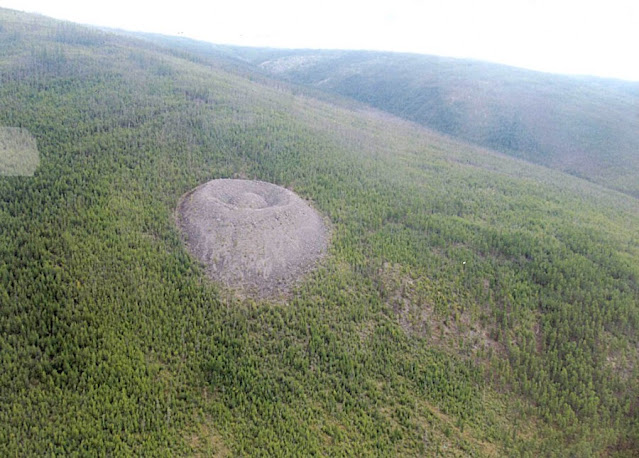 |
| An aerial view reveals the crater's distinctive ring-shaped structure and central mound. |
What Does the Patom Crater Look Like?
The Patom Crater has an extraordinary appearance from above. A wide ring-shaped mound surrounds a central depression, with a smaller raised hill within it. But it isn't just a big impact depression like a typical meteorite crater. It is made up mainly of broken limestone and other sedimentary rock. It looks more like a cone of rock than the more common impact basin. The structure has been studied, and several different zones have been identified, including an outer swell, an inner ring, a trench-like depression and a central mound. This complex arrangement was one of the key clues in attempts to understand how the formation evolved.
Patomskiy Crater: The Strange Geological Mystery of Siberia
 |
| Broken limestone and other rocks form the steep slopes of the unusual geological structure. |
The Mystery Behind Its Origin
The big question about the Patomskiy Crater for years was simple: what created it?
The first major explanation was the effect of a meteorite. The formation was so strange that scientists, who were actively studying impact structures at the time, found it, and a cosmic origin seemed possible. Theories even linked it to the famous Tunguska event. Detailed geological investigations found no convincing evidence of impact by a meteorite. A multidisciplinary team of geologists, geochemists, geophysicists and astronomers examined the site in detail. The rocks show no obvious meteorite material or geochemical anomalies expected from a cosmic impact, researchers said. It seemed more like the structure had been formed by processes within the Earth.
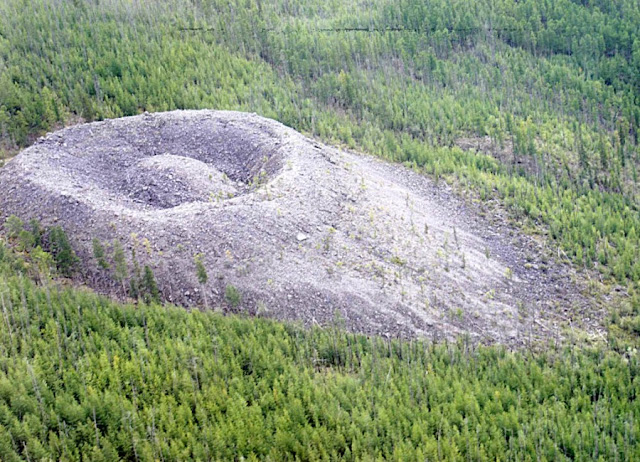 |
| The remote Patom Crater is surrounded by the vast Siberian taiga. |
A Geological Explosion?
One significant scientific explanation is the upward migration of deep geological fluids and gases through cracks in the Earth’s crust, which formed the Patom Crater.
Researchers at the Institute of Geochemistry of the Siberian Branch of the Russian Academy of Sciences, in their studies, concluded that the unusual cone was formed with the important participation of deep fluid movement. Another study later suggests a phreatic explosion, where underground water and heated geologic material can build up immense pressure and violently disturb the surrounding rocks.
This interpretation is consistent with the presence of heavily broken limestone in the Patom Crater and its structural complexity compared to a simple impact crater. Scientific literature does not confirm the popular notion that the Patom Crater is an active volcano. Its unusual appearance has led to comparisons with volcanic structures, but its geological composition and formation mechanism are different.
 |
| Patomskiy Crater is also known as the Kolpakov Cone after its discoverer, geologist Vadim Kolpakov. |
How Old Is the Patomskiy Crater?
Another fascinating feature of the Patom Crater is its surprisingly young age. Based on the growth history of Siberian larch trees, dendrochronological studies suggest that the formation dates to the late 15th or early 16th century. That is, the structure may be as young as 500 years, astonishingly recent in comparison with the vast geological age of the surrounding rocks. This makes the Patom Crater particularly remarkable to scientists. The surrounding limestone is part of ancient geological formations, but the strange cone itself appears to be relatively young.
 |
| The crater's unusual shape includes an outer swell, inner ring and central mound. |
Why Is the Patom Crater So Fascinating?
The Patomskiy Crater is of interest because it defies the simple idea that each crater-shaped landform was formed by a meteorite. Its remote location, strange shape, young apparent age and complex internal structure have made it one of the most remarkable geological formations in Siberia. Modern expeditions are still using geological and geophysical techniques to study the structure. In 2022, an expedition organised by the Russian Geographical Society conducted a ground-penetrating radar survey to learn about its internal structure and formation. The Patom Crater therefore serves as a rare natural laboratory, where ancient rocks preserve clues about a relatively recent geological event.
Patomskiy Crater: The Unusual Geological Wonder of Irkutsk
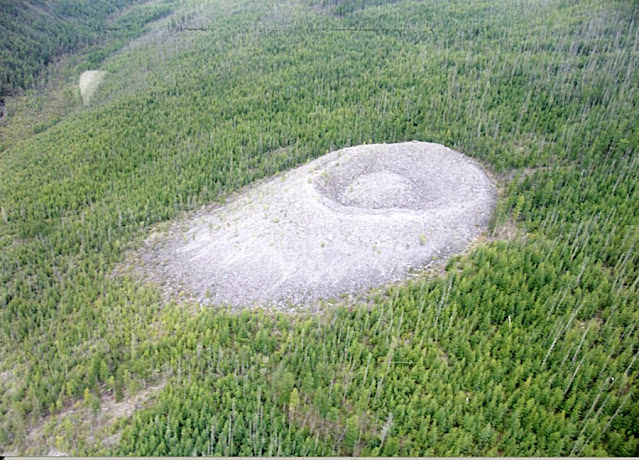 |
| The formation lies in a remote mountainous area of the Patom Highlands. |
Final Thoughts
The Patomskiy Crater is one of the most unusual natural formations in Siberia, located in the forests of the Patom Highlands in the Irkutsk Region. It was often associated with meteorite theories in the past, but increasingly geological and geochemical studies have pointed to an endogenic Earth process involving deep fluids, gases and rock disruption.
How it was formed remains a subject of scientific investigation, and perhaps its mystery is what makes the Patom Crater so intriguing. But this crater is no ordinary mysterious hole in the Siberian landscape. It is a rare geological formation that offers scientists a glimpse into powerful processes that are occurring deep below the Earth's surface.
Authentic scientific sources: The main source of evidence in this work is based on the research published in Doklady Earth Sciences, Lithology and Mineral Resources, Siberian Branch of the Russian Academy of Sciences, including the works of V. S. Antipin, A. M. Fedorov and colleagues.
References & Sources


No comments:
Post a Comment