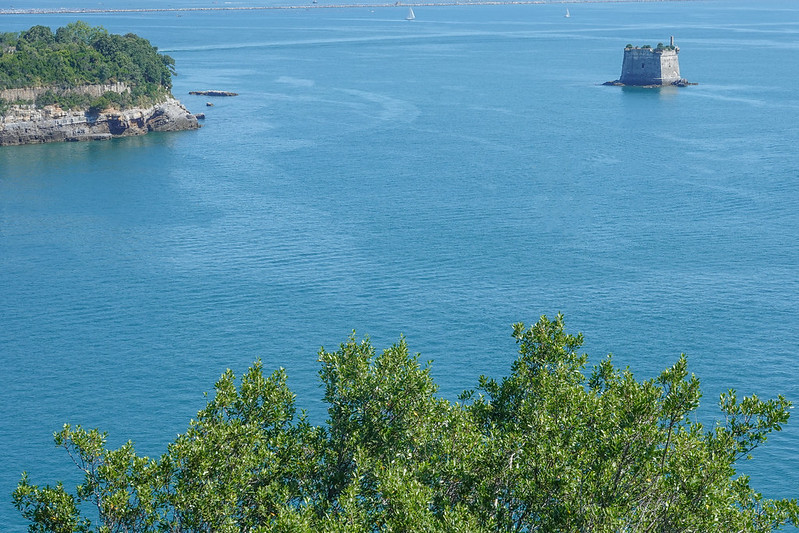
Out in the blue waters of Italy’s Gulf of Poets, a small stone fortress rises from an isolated rocky outcrop near Palmaria Island. At first glance, Scola Tower looks almost too small to have been a serious military installation. Yet for centuries, this lonely structure formed part of the defensive network protecting the coast around Porto Venere and the Gulf of La Spezia.

Also known as Torre Scola or the Tower of St John the Baptist, the fortress was built by the Republic of Genoa at the beginning of the 17th century. Its thick walls, cannons and strategic position allowed it to watch the waters around Palmaria, Porto Venere and the eastern side of the gulf.
Its military career ended after the fighting of 1800, when British cannon fire badly damaged the tower during clashes with Napoleon's forces. It was later abandoned, narrowly escaped demolition in the 20th century, and was restored in the late 1970s. Today, Scola Tower remains one of the most striking remnants of the old defensive landscape surrounding Porto Venere.
Where Is Scola Tower?
From trails on Palmaria Island, visitors can obtain views of Torre Scola across the water. The official Porto Venere tourism site specifically recommends viewpoints along the island's hiking route for seeing the tower. The location was not chosen for scenery. It was chosen because the tower could watch an important stretch of coastline.
The History of Torre Scola
Why Was Scola Tower Built?
The Republic of Genoa developed an extensive defensive system around Porto Venere and Palmaria. Scola Tower was constructed at the beginning of the 17th century, with the official Italian cultural heritage authority identifying it as a fortification commissioned by the Republic of Genoa.
The Porto Venere tourism authority dates the tower's construction to around 1600 and describes it as part of a coastal defence system. Its job was straightforward: it watched the sea and provided a fortified position from which defenders could challenge approaching vessels.
A Small Fortress With Very Thick Walls
Scola Tower has a distinctive pentagonal plan and remarkably substantial masonry. The official tourism source states that its walls are approximately four metres thick. It could accommodate soldiers and artillery and had a commanding view toward Palmaria, Porto Venere and the eastern shore of the gulf.
The Italian cultural heritage authority describes Torre Scola as a fortification standing on an isolated rock and identifies it as part of the wider defensive system of Palmaria and the Gulf of Poets. It is easy to imagine why such a position mattered in an age when ships approaching a harbour could be spotted long before they reached the shore.

Scola Tower and the Battle of 1800
The official Porto Venere tourism authority says English cannon fire effectively gutted the tower during these clashes. It subsequently fell into disuse and was abandoned. This is an important distinction when describing the tower today. It was not simply abandoned because it became old-fashioned. Its military history was interrupted by actual wartime damage. The ruined fortress then entered a very different phase of its existence.

The Fortress That Nearly Disappeared
Scola Tower Was Nearly Demolished in 1915
The story could have ended with the complete destruction of the tower. Instead, Scola Tower survived. A later restoration campaign helped preserve the structure, and the tower remains visible today as part of the historic military landscape around Palmaria and Porto Venere. The Italian cultural heritage record identifies Torre Scola as a protected historic fortification and documents its place within the defensive system of the area. This survival is particularly remarkable because the tower had already endured warfare, abandonment, and exposure to the sea.
Restoration of Scola Tower

Scola Tower Today
Palmaria itself contains several other former military installations. The official tourism authority describes Fortezza Umberto I as a restored fortress open to the public, while Forte Cavour occupies the upper part of the island. Scola Tower is different in character. Its isolated position on the sea makes it especially photogenic, but the best way to appreciate it is often from the surrounding coastline or from Palmaria Island. The official Palmaria hiking information specifically highlights viewpoints from which hikers can admire Torre Scola.
Can You Visit Scola Tower?
For anyone planning a visit, it is therefore better to think of Scola Tower as a historic landmark to view from the surrounding area, rather than a fortress where visitors can simply walk inside. Porto Venere itself has good road and public transport links to La Spezia, and seasonal boat services connect the area with surrounding destinations.

Why Scola Tower Is Worth Remembering
And the landscape around it makes the story even better. Palmaria Island, Porto Venere, the Gulf of La Spezia, and the surrounding Ligurian coast all remain part of the same view that made this location strategically valuable centuries ago. That combination of history, architecture, and isolation is what makes Scola Tower such an intriguing place.

Frequently Asked Questions About Scola Tower
When was Scola Tower built?
Scola Tower was built at the beginning of the 17th century as part of the defensive system established by the Republic of Genoa around Palmaria and the Gulf of Poets.
Where is Scola Tower located?
Torre Scola stands on an isolated rocky outcrop near Palmaria Island, opposite Porto Venere in Liguria, Italy.
Why was Scola Tower built?
The fortress was built as part of Genoa's coastal defense system. Its position allowed it to watch important stretches of the sea around Palmaria, Porto Venere and the Gulf of La Spezia.
What happened to Scola Tower in 1800?
During fighting in 1800 involving British and French forces under Napoleon, Scola Tower was severely damaged by British cannon fire. It subsequently fell into disuse and was abandoned.
Was Scola Tower demolished?
No. Although the fortress suffered severe damage and later deterioration, the surviving structure was restored in the late 1970s.
Can you visit Scola Tower?
The tower can be admired from viewpoints around Palmaria Island and the surrounding coast. Official tourism information highlights views of Torre Scola from Palmaria's hiking trails.




Conclusion
Scola Tower is one of those places that becomes more fascinating the more closely you look at it. From a distance, it is simply a small stone fortress standing alone in the sea. Look into its history, however, and the tower becomes a survivor of Genoese military planning, Napoleonic-era warfare, abandonment, and restoration.
Built around the beginning of the 17th century, Torre Scola guarded the waters around Palmaria and Porto Venere before being badly damaged during the fighting of 1800. After years of neglect, it was restored in the late 1970s and preserved as part of the historic landscape of the Gulf of Poets. Today, the tower's greatest attraction may be its setting. Surrounded by the blue waters of the Ligurian coast and viewed against Palmaria Island and Porto Venere, it remains a striking reminder of the time when small coastal fortresses played an important role in controlling the Mediterranean shoreline.
References & Sources

No comments:
Post a Comment