In the very centre of southwestern Libya, where waves of golden sand continue without end all the way to the horizon, lies one of the Sahara Desert's most surreal hidden gems: the Ubari Lakes.
There's a remarkable sensation when you stand on the edge of a 300-foot dune in the Ubari Sand Sea and look down into a vivid blue-green lake surrounded by thick green palm trees—one that is exactly like stepping into a desert mirage. Yet these lakes are real, and their astonishing story of survival in one of the hottest places on Earth is remarkable.
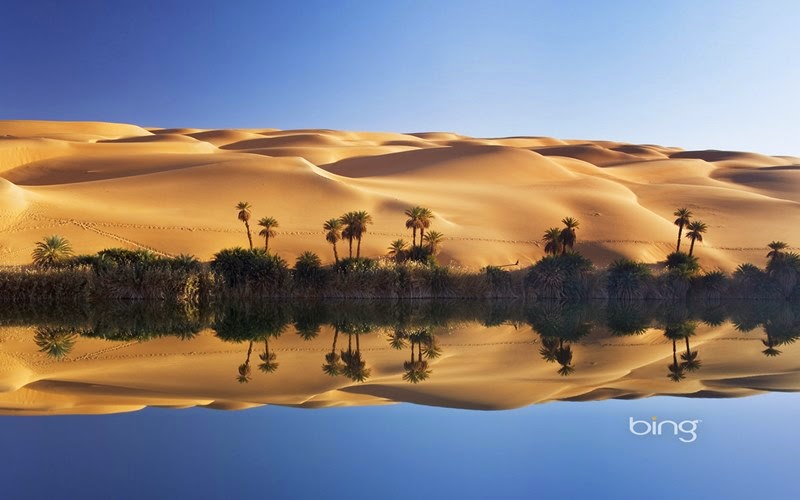 |
| The beautiful Lakes of Ubari are surrounded by towering Sahara sand dunes. |
The Ubari Lakes and the Sahara Sand Sea
The history of the Ubari Lakes does not take place in a dry desert; instead, it dates back about 200,000 years to a time when monsoon rains had completely altered Africa's climate. At that time, the Sahara was not a barren, sun-scorched desert but a rich, green area with rivers, savannas, and large bodies of water.
The Era of Lake Megafezzan
The largest of the lakes was Lake MegaFezzan, an ancient inland sea that covered an area of
120,000 square kilometres (almost the size of England). For thousands of years, it supported a wide variety of wildlife, aquatic life, and early human settlements. [
source]
How Did Lakes Form in the Middle of the Sahara?
About 3,000 to 5,000 years ago, the general weather patterns changed. The monsoons withdrew, the rainfall ceased, and the large sea started to dry up under the harsh sun. Almost all of it evaporated, so what remained were about 20 lakes distributed over the sand. The explanation for why these lakes did not disappear completely is that the surface of the desert is low enough between the dunes to reach directly into the Nubian Sandstone Aquifer—a huge underground store containing ancient "fossil water" that has been trapped beneath the rock for thousands of years.
From Ancient Lakes to the Ubari Sand Sea
How Deep Are the Lakes Really?
The lakes appear surprisingly resilient, even though huge dunes always try to engulf them.
- The lakes are mostly between 7 and 32 metres (23 and 105 feet) deep.
- The lake known as Gaberoun has a depth of about 7.5 metres (25 ft) at its centre.
- In the deepest basins, some lake-like sinkholes reach a depth of 35 metres.
What is even more remarkable is that surface evaporation in the Sahara is severe—amounting to a loss of up to 5 metres of water depth each year—yet the lakes do not dry out overnight because the underground aquifer constantly supplies pressurised fossil water to refill them from below.
 |
| The remarkable desert lakes of the Fezzan region in southwestern Libya. |
Salty Waters and Bizarre Dynamics
Since these lakes have no rivers flowing out, any water that enters can only escape by evaporating. Over thousands of years, as a result of this process, all the minerals have been left behind, and the water has thus become a highly saline mixture.
The salinity is extremely high; the water in some of the lakes at Ubari reaches a salt content up to five times that of the ocean (ranging from 30% to 35%). Just as in the Dead Sea, swimming there is not really something you do—you instead float easily on the water.
The thermal profiles of these lakes are just as odd: although the surface waters reach a warm temperature of 25°C to 35°C (77°F to 95°F) in summer, the deeper layers can, in fact, be warmer than the surface due to dense salt traps that retain both solar and geothermal heat.
Umm al-Maa: The Mother of Water in the Sahara
Bright red colours: Although it may seem that nothing could survive in such extreme conditions, hardy microalgae and small brine shrimp do, in fact, thrive in this area. In some seasons, the lakes, such as Umm al-Maa ("Mother of Water"), become remarkable shades of deep crimson due to extensive blooms of red algae.
Why Are Some Ubari Lakes Disappearing?
Although these lakes have survived for thousands of years, they are now encountering unprecedented difficulties since regional agricultural schemes are drawing large quantities of water from the underground Nubian aquifer and thus lowering the water table. Together with the continuous natural process of evaporation, some of the smaller lakes—like Mandara—have already turned into flat salt pans. The lakes that remain act as a clear indication of the Sahara's once-lush condition and exist as a fragile miracle on the brink of survival.
 |
| Turquoise water creates a striking contrast with the golden dunes of the Sahara. |
 |
| Gaberoun Lake is one of the best-known desert lakes in the Ubari region. |
 |
| Umm al-Maa is a spectacular desert lake hidden among the dunes of Libya. |
 |
| The Erg Ubari Sand Sea contains extraordinary lakes surrounded by immense dunes. |
 |
| An isolated lake contrasts dramatically with the vast Sahara desert dunes. |
 |
| The Ubari region preserves evidence of major environmental changes in the ancient Sahara. |
 |
| Water and enormous dunes create one of the Sahara's most unusual landscapes. |
The Lakes of Ubari Sand Sea Map
Ubari Lakes | The Beautiful Oasis In The Sahara desert — Video  |
| Ancient water systems helped shape the remarkable landscape of the Fezzan region. |
Conclusion
The Lakes of Ubari in Libya are truly remarkable. They show us what the Sahara Desert was like a long time ago. A long time ago, the Fezzan region had lakes, and the weather was not as dry as it is now. The Lakes of Ubari also had people living there a long time ago. 200,000 years ago, the whole area around the Lakes of Ubari went through some significant changes. These changes affected the lakes and the plants that grew there. They also changed the way water flowed through the area.
The Lakes of Ubari and the Sahara Sand Sea are really cool to look at today. The story of the Lakes of Ubari is about how the weather changed a long time ago and how that affected the lakes and the people who lived there. The Lakes of Ubari are a way to learn about the history of the Sahara Desert. The Lakes of Ubari tell us about the geology, the fossil water, and the human history of the area. This makes the Lakes of Ubari an engaging place to learn about the Sahara Desert and its past.

No comments:
Post a Comment