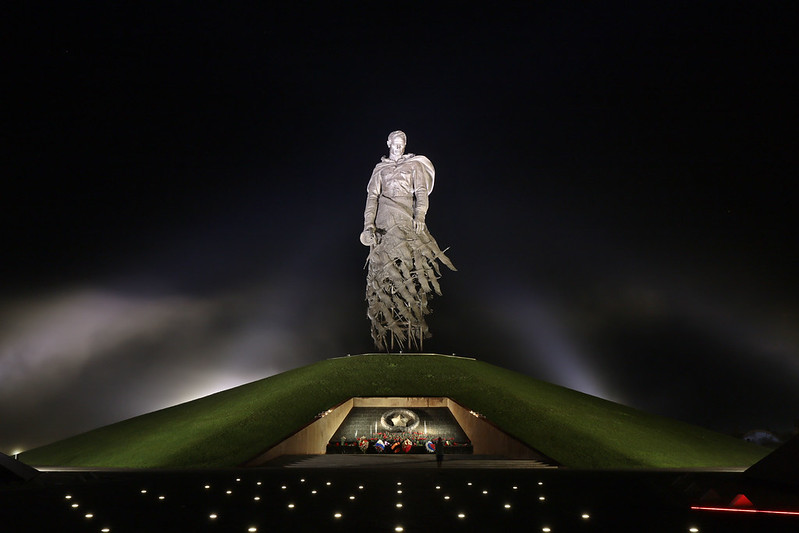
The Rzhev Memorial to the Soviet Soldier stands in open farmland in Rzhevsky District, Tver Oblast, about 7 km southwest of the town of Rzhev and roughly 200 km northwest of Moscow. Its centrepiece is a 25-metre bronze soldier on a 10-metre mound, rifle in hand and head slightly lowered. The memorial was ready by April 2020, but the pandemic held back the ceremony. It was finally opened on 30 June 2020 with Russian president Vladimir Putin and Belarusian president Alexander Lukashenko in attendance.
 |
| A line from Alexander Tvardovsky’s poem “I Was Killed Near Rzhev” is one of the few public references to the battles of Soviet times. |
The idea came from veterans of the Great Patriotic War, who wrote in 2017 asking for a memorial to the men killed in the fighting around Rzhev. An international competition followed, and the winning design came from sculptor Andrei Korobtsov and architect Konstantin Fomin. The project was backed by the Union State of Russia and Belarus, the Russian Ministry of Culture and the Tver regional government, and Lukoil supported the construction. The soldier does not stand in a victorious pose. He simply stands and looks down, while the lower part of the figure breaks up into a flock of cranes, an image borrowed from Rasul Gamzatov’s poem “Zhuravli”. Next to the statue there is a multimedia museum with archive documents, photographs and video, run as a branch of the Victory Museum on Poklonnaya Hill in Moscow.
The reason for the monument lies in the Battles of Rzhev. German troops had taken the town on 14 October 1941, and between 8 January 1942 and 31 March 1943, the Red Army launched a series of offensives against the German-held salient around it. Veterans called the campaign the Rzhev Meat Grinder. According to the historian A. V. Isayev, Soviet losses came to 392,554 killed or missing and 768,233 wounded or sick, for more than 1.1 million in all, and the official figures omit several months. Another researcher, Gerasimova, estimates about 2.3 million once she includes the sick and captured. German losses are harder to estimate, and the frequently cited range of 350,000 to 400,000 is not well supported by documents. The Germans eventually pulled out of the salient in March 1943.
For many years these battles were treated as a footnote in Soviet military history. One of the few mentions in Soviet culture was Alexander Tvardovsky’s poem, “I Was Killed Near Rzhev". The memorial provides a physical landmark for the fighting, visible from miles away. Memorial mounds are an old idea in Europe, as the Kosciuszko Mound in Kraków shows, and giant sculptures placed in empty landscapes have a pull of their own, much like the Mano del Desierto in Chile’s Atacama Desert.
First Image Credit: Wikimedia Commons
 |
| The Rzhev Memorial to the Soviet Soldier was opened on 30 June 2020, the day it was officially inaugurated. |
 |
| The Rzhev Memorial to the Soviet Soldier in Rzhev, Russia, honours the Soviet soldiers who fought and died during World War II. Photograph by Ded Pihto, taken on July 27, 2020. Photo - Ded Pihto |
 |
The Rzhev Memorial to the Soviet Soldier in July 2020, a few weeks after its opening. Photo: Ded Pihto. |
 |
| The 25-metre soldier rises above a corridor of steel plates inscribed with the names of the fallen. Photo: Dmitry Shugarev. |
In short, the Rzhev Memorial to the Soviet Soldier is a 25-metre bronze monument opened in 2020 to remember the soldiers lost in the Battles of Rzhev. Its quiet design, the crane motif and the scale of the losses behind it explain why it has become one of the better-known Second World War memorials in Russia. The exact casualty numbers will keep being debated, but the monument shows how much that stretch of the front cost.
References & Sources
- Rzhev Memorial to the Soviet Soldier – Wikipedia
- Battles of Rzhev – Wikipedia
- Rzhev – Wikipedia
- Andrei Korobtsov – Wikipedia
- Putin and Lukashenko open the Rzhev Memorial – may9.ru (archived)
- Memorial to the Soviet Soldier opens near Rzhev – Lukoil press release
- Union State contributes to Rzhev memorial – IACIS
- Rzhev community history – Yad Vashem
- History of the Rzhev memorial – Meduza
- The Rzhev Memorial to Soviet Soldiers – Amusing Planet

No comments:
Post a Comment