Kolmanskop is an abandoned diamond-mining town in the Namib Desert, a short distance from the coastal town of Lüderitz in southern Namibia. Its rise began with a single diamond found beside a railway track in 1908. Within a few years, the settlement had become one of the wealthiest mining towns in German South West Africa. By 1956, its last residents had left. Today, windblown sand fills its houses, corridors and former public buildings.
 |
| Sand gradually takes over the abandoned buildings of Kolmanskop, a former diamond-mining town in Namibia’s Namib Desert. |
The story began in April 1908, when Namibia was still under German colonial rule. A railway worker named Zacharias Lewala was clearing sand from the tracks near Kolmanskop when he picked up a stone that caught his attention. Lewala had previously spent time in the Kimberley diamond fields of South Africa. He handed the stone to his supervisor, August Stauch, a German railway foreman interested in mineralogy. Stauch sent it for testing, and it proved to be a diamond. News of the discovery soon spread, drawing prospectors and mining companies to the area. (World Diamond Council)
The German colonial administration responded by declaring a vast coastal area a restricted diamond zone known as the Sperrgebiet, meaning “forbidden territory”. Prospecting was tightly controlled, and Kolmanskop became the centre of an expanding diamond-mining industry. (Geological Survey of Namibia)
The town developed rapidly, with substantial houses and facilities that were unusual for such a remote desert settlement. Its residents had access to a hospital, ballroom, casino, theatre, ice factory and other amenities. Electricity and imported supplies helped support a lifestyle that contrasted sharply with the surrounding desert. The hospital was equipped with what the World Diamond Council describes as the first X-ray machine in southern Africa. Water, a scarce resource in the region, had to be brought in from elsewhere. (World Diamond Council)
The town’s name is generally linked to a transport driver named Johnny Coleman. According to the traditional account, he abandoned his ox waggon near a small hill during a sandstorm in 1905. The place became associated with “Coleman’s Hill”, reflected in the Afrikaans name Kolmanskop. (Kolmanskop historical timeline)
Kolmanskop’s prosperity did not last. The First World War interrupted diamond mining, although operations resumed afterwards. In 1928, richer diamond deposits were discovered in the coastal terraces near the mouth of the Orange River, farther south. Attention gradually shifted away from the older mining area. The worldwide economic depression also affected the industry, and the central processing plant at Kolmanskop stopped operating in April 1930. (Geological Survey of Namibia)
The mining company eventually moved its headquarters to Oranjemund, and Kolmanskop lost the economic purpose that had sustained it. The hospital closed, and the last families left in 1956. (University of Cape Town research)
The buildings began to fall into disrepair without regular maintenance. Sand blew through broken windows and open doors, coating floors and filling rooms that once had held furniture and the debris of daily life. Some houses are now almost filled to their ceilings. The contrast between the remaining architecture and the surrounding dunes has made Kolmanskop a familiar subject for photographers.
The site was later developed into a heritage attraction. In 2002, the private company Ghost Town Tours received the concession to manage visits to the abandoned settlement. (National Geographic)
First Image Credit: Wikimedia Commons
 |
| The abandoned settlement of Kolmanskop near Lüderitz, where former diamond-mining buildings stand in the Namib Desert. |
 |
| A rusted electricity pole stands above the ruins of Kolmanskop, a former diamond-mining settlement in Namibia’s Namib Desert. |
 |
| An old electrical switchboard remains inside an abandoned building at Kolmanskop, the former diamond-mining settlement in Namibia. |
 |
| Abandoned buildings at Kolmanskop, the former diamond-mining settlement in Namibia, photographed by Reinhard Kraasch. |
 |
| Abandoned buildings remain at Kolmanskop, a former diamond-mining settlement near Lüderitz in Namibia. |
 |
| Desert sand has gradually entered the abandoned buildings of Kolmanskop, the former diamond-mining town in Namibia. |
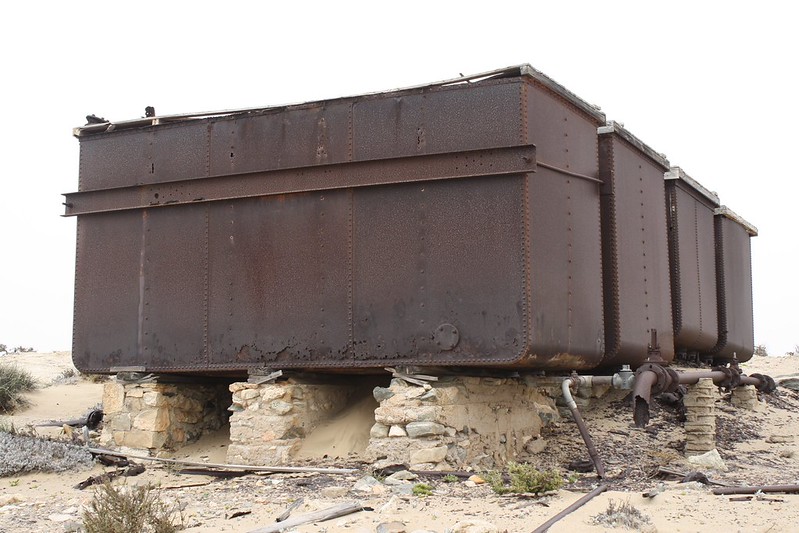 |
| Abandoned buildings at Kolmanskop, the former diamond-mining settlement in Namibia's Namib Desert. |
For more unusual landscapes shaped by their surroundings, read about Lake Yueyaquan in the Dunhuang desert and the Marble Caves of General Carrera Lake in Chile.
References & Source

No comments:
Post a Comment