Auricularia auricular, or Jelly ear fungus, is a fungus of the Auriculariaceae family. The popular name of the mushroom Judas ear in many European languages comes from the biblical legend of Judas Iscariot, who hanged himself on an elderberry.
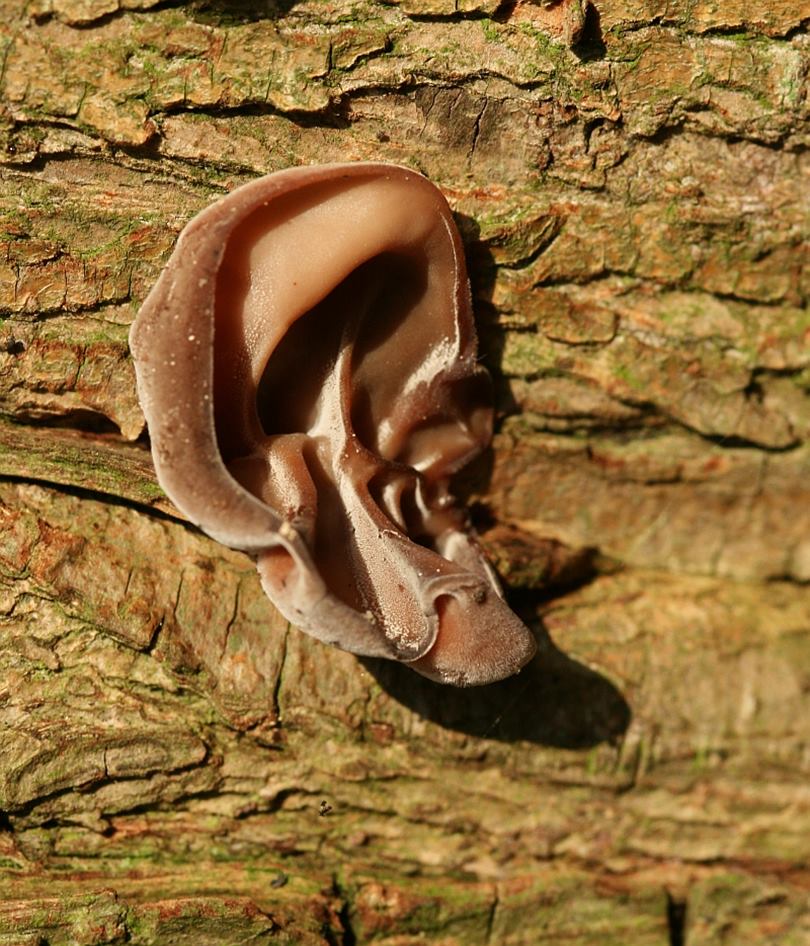 |
| Wood ear mushroom |
Wood Ear Fungus
This mushroom got its name for its resemblance to the human ear, commonly known as the Jewish ear, Jewish meat, wood ear, dried wood Ear, ear mushroom, elf ear mushroom, elves ear mushroom, ear jellies, mouse ear mushroom, bat ear mushroom, jelly ear, jelly ear mushroom, jelly ear fungus, auricularia, auriculariales fungus, auricularia mushroom, tree ear, tree ear mushroom, tree ear fungus, dried wood Ear, Judas's Ear, auricularia fungi, wood ear fungus, or wood ear mushroom. The official Latin name also mentions Judas. The reason for its name is again very "logical" – most often, auricularia can be found on the felled trunks of elms or elderberries. And, as everyone knows, Judas hanged himself on the elderberry. Therefore, the mushroom officially began to bear his name.
In ancient medical books, it is indicated that the mushroom "Wood Ear Mushroom", found in the Caucasus and the Far East in the form of gristly-gelatinous yellowish-brown or reddish-brown ear-like growths on dead wood, helps with some throat diseases. "Wood ear" is one of the artificially grown mushrooms. Its annual production in the Far East reaches 120 thousand tonnes. Some specimens are very similar in shape to human ears.
It grows on dead wood, especially on elder branches. Edible. Previously, this mushroom was used in medicine as an external cooling agent for sore throats and eyes, and it is still popularly used for this purpose in some places. In Southeast Asia and the Far East, this mushroom and related species, called "tree ears", are considered a delicacy and are even grown artificially.
The Chinese name for the mushroom is mu er, which translates as "tree ear." The Japanese name is kikurage and means tree jellyfish. The mushroom is also often called 'Jelly Ear', 'Ear Mushroom' or 'Kikurage food'.
These mushrooms can be found throughout the year, but autumn mushrooms are most visible, especially after rain. Autumn mushrooms are more challenging and more resilient, so people often leave them unharvested.
There is evidence that these mushrooms were grown in China over 1,500 years ago. Judas' ears grow up to 3 cm across, although specimens up to 12 cm wide are often found in nature. The mushroom is rigid, jelly-like, and elastic to the touch. The mushroom is prized in the Far East. It is an obligatory ingredient in Chinese Black Mushroom soup.
Dense hairy auricularia: How to recognise the "tree ear fungus".
The colour of this tree inhabitant is dark olive or brown on the outside of the cap. Inside, it is grey-purple or pinkish-grey. The upper part of the cap has a glossy sheen, while the bottom is covered with a thick layer of hairs. The fungus is large – adult specimens reach 14-18 cm in diameter, the cap height is up to 10 cm, and its thickness is only a couple of millimetres. The stalk often either grows minimally and is almost invisible or is absent altogether. Visually, the mushroom resembles the human ear, for which it received the "eared" name among the people.
 |
| Jelly ear mushroom |
Photo credit: Simon Merrifield
Jelly Ear Mushroom
The smell is a mild mushroom, and the consistency of the mushroom pulp resembles cartilage, but it has a softer, gelatinous structure. Auricularia tolerates drought well – at this time, it simply withers and shrinks, but after the first rain, it regains its original shape.
Distinctive features of Auricularia auricula or "Judae"
Like its closest relatives, this fungus subspecies is similar in shape and appearance to the human organ of hearing. In comparison with the thick-haired auricularia, the similarity is further aggravated by the colour of the cap: it can be grey-brown or reddish-brown in dry weather, and after rain, it becomes dark olive or yellow-brown. Its diameter ranges from 5 to 10 cm. The hat is attached to the trunk sideways, shaped like a shell, and has veins and cells. The flesh of the cap can be 2-3 mm thick, has no particular smell, and has a gelatinous consistency.
 |
| Jelly ear fungus |
Photo credit: Solange B
Auricularia sinuosa or membranous: Features of appearance
The membranous subspecies resemble a disc, unlike the pear-shaped and densely haired varieties, which are very reminiscent of a shell in their shape. The semicircular cap gradually straightens over time, developing into lamellar forms. In width, they reach 8-12 cm, and in thickness, they reach no more than 4-5 millimetres.
There are concentric grooves on the outside of the cap. Between them, there are also parts of a dark brown colour. The general colour of the mushroom is light grey, beige, or brown. There are specimens with a greenish bloom; the cause is moss or algae. The underside of the cap has a wrinkled, sinewy surface and is brownish-purple in colour. The soft, elastic, and tasteless pulp, even without beneficial properties, has not gained much popularity either among mushroom pickers or doctors.
 |
| Jelly ear |
Photo credit: Staatsbosbeheer
 |
| Jelly ear mushroom |
Photo credit: Staatsbosbeheer
 |
| Judae |
Photo credit: Rosey
 |
| Auricularia Auricula |
Photo credit: Joy
 |
| Auricularia Auricula-Judae |
Photo credit: Gidzy
 |
| Auricularia sp. |
Photo credit: Solange B
 |
| Auricularia fungi |
Photo credit: honderd woorden
 |
| Judas's Ear |
Photo credit: Szabo Jozsef (iosif)

No comments:
Post a Comment