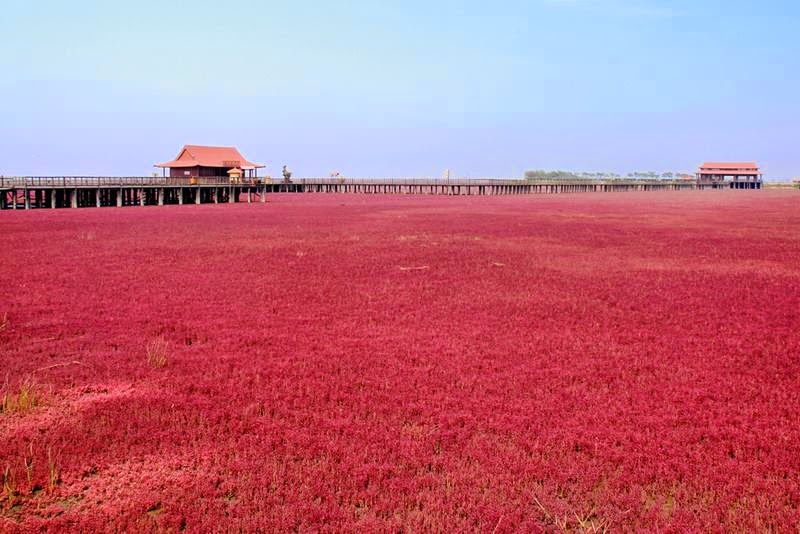
For much of the year, the coast near Panjin in northeastern China looks like an ordinary wetland. Then the landscape begins to change. Salt-tolerant plants spread across the tidal flats, and as autumn approaches, their green vegetation turns shades of red. From a distance, the wetland can look like an immense crimson carpet stretching toward the water.
 |
| Panjin Red Beach in Liaoning, China, transforms into a vivid red in autumn thanks to salt-tolerant Suaeda vegetation. |
This is Panjin Red Beach, one of China's most unusual natural landscapes. Despite its name, it is not a conventional sandy beach. The famous colour comes from Suaeda, a salt-tolerant wetland plant that thrives in the saline conditions of the Liaohe River Delta.
Panjin Red Beach lies in Panjin, Liaoning Province, where rivers meet the coastal waters of the Bohai Sea. The combination of mudflats, tidal channels, reeds, and salt-tolerant vegetation has created a landscape that changes dramatically with the seasons. The Panjin Municipal Government continues to identify the Red Beach as one of the city's signature wetland attractions.
What Is Panjin Red Beach?
Panjin Red Beach is a coastal wetland covered by salt-tolerant vegetation that becomes intensely red during part of the year. It is associated with the Liaohe estuary wetland in Panjin and is widely recognised for its unusual seasonal landscape. The Chinese name for the vegetation is often translated as 'Suaeda' or 'Suaeda salsa' in English-language sources. Rather than calling it seaweed, as some older descriptions do, it is more accurate to describe it as a salt-tolerant wetland plant.
The plants can survive in the salty, waterlogged environment where many other species would struggle. Their ability to grow across the tidal landscape is responsible for the broad red appearance that gave the place its famous name. The official city information describes the Red Beach as a wetland landscape in which the red salt-tolerant vegetation is complemented by reed marshes, rice fields, and migratory bird habitat.
Where Is Panjin Red Beach?
Panjin Red Beach is located in Panjin, Liaoning Province, in northeastern China. The landscape lies within the Liaohe River Delta, one of the important wetland regions along China's northeastern coast. Panjin itself sits in the centre of the Liaohe Delta and is characterised by a very large wetland area. The municipal government describes the city as a major wetland area where rivers and the sea meet.
The surrounding environment is important to more than tourists. It provides feeding, breeding, and resting habitat for birds moving along regional migration routes. Panjin's wetlands are particularly noted for species such as the red-crowned crane and black-billed gull.
 |
| Red Beach, China |
Why Does Panjin Red Beach Turn Red?
This is the question most people ask when they first see photographs of the place. The answer lies in the salt-tolerant Suaeda vegetation. The plants live in saline coastal mudflats and change appearance as the growing season progresses. By late summer and autumn, much of the vegetation takes on increasingly vivid red tones.
Recent information published by the Panjin government describes the main viewing period as August to October, with the strongest red colouration appearing in late September and October. The plants contain pigments that contribute to their red colouration, and the local environment—including salinity—plays an important role in how the vegetation develops. The result is a landscape that can shift from greener tones earlier in the season to deep red later on.
The Salt-Tolerant Suaeda Plants
Suaeda is particularly well suited to saline coastal conditions. As a pioneer plant, it can establish itself on difficult salt-affected ground and help create conditions in which other vegetation can eventually take hold. That ecological role makes the Red Beach more than just a colourful tourist attraction. The vegetation is part of a functioning wetland ecosystem.
 |
| Panjin Red Beach |
Is Panjin Red Beach Really a Beach?
Not in the usual sense. When people hear the word "beach", they usually picture sand, waves, and a broad shoreline. Panjin Red Beach is better understood as a coastal wetland and salt marsh. Instead, the giant sandy shoreline is absent, and the red material is not present. Instead, the striking colour comes from the vegetation growing across the wetland.
The Panjin government has explicitly described the Red Beach as a wetland rather than a conventional beach, with red Suaeda vegetation forming its signature landscape. That distinction makes the place even more remarkable. The name describes how it looks, not the geological type of shoreline it actually is.
When Is Panjin Red Beach at Its Reddest?
The colour changes throughout the year, so timing is important for visitors hoping to see the famous crimson landscape. According to current local information, August through October is the main period for viewing the red wetland, with late September and October generally associated with the strongest autumn display.
The exact appearance naturally varies from year to year because the vegetation responds to environmental conditions. A photograph taken during peak autumn colour can look dramatically different from one taken earlier in the growing season. This seasonal change is one of the reasons the Panjin Red Beach feels more like a living landscape than a fixed attraction.
 |
| Panjin Red Beach |
Panjin Red Beach and the Liaohe River Delta Wetland
The Red Beach is only one part of a much larger ecological landscape. Panjin's wetlands include reed marshes, tidal waterways and coastal habitats that support a wide range of wildlife. The city's wider wetland area is especially significant for migratory birds, while the Liaohe estuary has long been recognised for its biodiversity.
The region is also an important stopover area for birds travelling along migration routes. Among the better-known species associated with Panjin's wetlands are red-crowned cranes and black-billed gulls. That means visitors looking beyond the red vegetation can find another side of Panjin: a broad wetland ecosystem shaped by the interaction of freshwater rivers, coastal water and salt marshes.
Protecting Panjin’s Red Wetland
The future of the Red Beach depends on the health of the wetland itself. Recently, Panjin has invested in wetland conservation and ecological restoration. Environmental programmes have focused on restoring salt-marsh vegetation and improving the condition of the Liaohe estuary ecosystem. A 2024 government report described ongoing efforts to protect wetland biodiversity and restore degraded coastal habitats.
More recent municipal reporting says restoration projects have helped expand the area of recovered Suaeda vegetation substantially since 2018. This is an important part of the Red Beach story. Its remarkable colour may attract visitors, but the true value of the landscape lies in its ecology.
 |
| Red Beach, Panjin, China |
What Makes Panjin Red Beach So Unusual?
The attraction is not simply that the plants are red. It is the combination of several things happening in the same place. A coastal wetland becomes covered by seasonal vegetation. The plants change colour. Tidal channels cut through the marsh. Reed beds rise beyond the red flats. Migratory birds arrive. And for a few weeks in autumn, the entire landscape can look entirely different from its appearance earlier in the year.
The result is something difficult to confuse with an ordinary beach. Panjin's current tourism information even promotes the area as a destination for autumn viewing, wetland birdwatching and local food experiences, showing how closely the natural landscape is connected with the city's wider culture and tourism economy.
 |
| Red Beach, Panjin, China |
Frequently Asked Questions
What is Panjin Red Beach?
Panjin Red Beach is a coastal wetland in Panjin, Liaoning Province, China, famous for its broad areas of salt-tolerant vegetation that become red during late summer and autumn.
Where is Panjin Red Beach located?
It is located in Panjin in Liaoning Province, northeastern China, within the wider Liaohe River Delta wetland region.
Why is Panjin Red Beach red?
The red colour comes from salt-tolerant Suaeda vegetation that grows across the coastal wetland. The plants change colour as the growing season progresses, producing the famous autumn display.
What plant makes Panjin Red Beach red?
Suaeda, a salt-tolerant wetland plant adapted to the area's saline environment, creates the characteristic red landscape.
Is Panjin Red Beach a real beach?
It is called a beach, but it is more accurately described as a coastal wetland or salt marsh rather than a conventional sandy beach.
When is the best time to see Panjin Red Beach?
Current local tourism information identifies August to October as the main viewing period, with late September and October generally offering the strongest red colouration.
 |
| Red sea in China |
 |
| Red sea in China |
 |
| Red beach |
 |
| The Red Beach in Panjin, China |
Red Beach China Map
 |
| An elevated walkway provides views across the red wetland landscape of Panjin Red Beach. |
Conclusion
Panjin Red Beach is one of those rare places where the landscape seems to have been painted rather than grown. There are no fields of red sand here, nor any artificial colouring. The extraordinary appearance comes from a salt-tolerant plant thriving in a demanding coastal wetland.
Its seasonal transformation is only part of the story. Beneath the famous red landscape is an ecosystem of tidal flats, reeds, waterways and wildlife that forms part of the much larger Liaohe River Delta. Conservation work is therefore just as important as tourism.
For a short period each year, the vegetation turns the wetland into a vast red landscape. That is what has made Red Beach China such a memorable natural attraction—and why Panjin remains one of the most unusual wetland destinations in the country.
References & Sources
- Panjin Municipal Government: Red Beach
- Panjin Municipal Government: Panjin Overview
- Panjin Municipal Government: Red Beach National Scenic Corridor
- Panjin Municipal Government: Red Beach autumn landscape
- Panjin Government: Protecting the Red Beach Wetland
- Panjin Municipal Government: Liaohe Estuary Wetland Restoration

No comments:
Post a Comment