Here, El Agua, or The Water Boils, is a set of natural rock formations in the Mexican state of Oaxaca that resemble cascades of water. The site is located about 70 km east of Oaxaca City, past Mitla, in the municipal division of San Lorenzo Albarradas, with a narrow, winding, unpaved road leading to it. At first glance, this formation looks like a frozen waterfall, which in itself is impossible, given the mild climate of southern Mexico. But in fact, it is a stone waterfall, which sounds even less likely, yet is quite real.

This wonderful waterfall, which looks petrified, is a tourist attraction known as Boiling Water. Natural mineral springs that attract crowds of tourists are also responsible for the formation of this unprecedented geological feature. Once there was a waterfall, but its mineral-rich waters dried up, leaving a stone formation.
The site consists of two rock shelves or cliffs which rise between fifty and ninety metres from the valley below, from which extend nearly white rock formations that look like waterfalls. These formations are created by freshwater springs, whose water is oversaturated with calcium carbonate and other minerals. As the water scurries over the cliffs, the excess minerals are deposited, much in the same manner that stalactites are formed in caves. One of the cliffs, called the "cascada chica" (small waterfall) or the Amphitheatre, contains two large artificial pools for swimming as well as a number of small natural pools. One of the artificial pools is very near the edge of the cliff. [Text Link]
First Image credit: Kieran Lynn

Image credit: Thomas Buhrmann
The site features two waterfall-like rock formations that have taken thousands of years to form. Both cliffs rise over 50 metres from the valley floor, with impressive petrified waterfalls (calcium carbonate) formed thousands of years ago by the carbonated water runoff. From springs, water falls over rugged cliffs that are over 50 metres high, with one rock formation reaching down twelve metres and the other reaching down thirty metres. The twelve-metre one is called "cascada chica" (small waterfall) and "flows" from a base that is about sixty metres wide. The other, "cascada grande" (large waterfall), extends down from a base that is about ninety metres wide and eighty metres above the valley floor. [Text Link]

Image credit: David Matzdorf
The rock formations are often described as "cascadas de sal" (salt waterfalls), "cascadas petrificadas" (petrified waterfalls), and "cascadas pétreas" (rock waterfalls). The falls are formed by relatively small amounts of water that are oversaturated with calcium carbonate and come to the surface through cracks or fissures on the mountainside. The water has a temperature of 22 to 27C. As the water runs down the rock face, it forms large stalactites similar to those found in caves. The flow of water from the spring varies significantly between the dry and rainy seasons. 95% of the surface rock formations are of calcium carbonate; however, the lower layers of both rock and water currents are little known, as they are sealed by the above layers. The calcium carbonate imparts the formations a white or near-white appearance, but other minerals that can be present in the water, such as silver, barium, and iron, can also be found and determine the colour of a particular stalactite. The calcium carbonate in the water is due to rainwater that passes underground. First, it absorbs carbon dioxide and forms molecules of carbonic acid. This acid comes into contact with underground marble and partially dissolves, creating calcium bicarbonate. When the water runs above ground, the excess minerals fall out. [Text Link]

Image credit: Brecht Soenen
The waters, with their high mineral content, are reputed to have healing qualities. The more easily accessible and more often visited of the two waterfalls is the "cascada chica", also called the Amphitheatre. This cliff rises over fifty metres above the valley floor, where there is a natural platform about sixty metres wide. This platform has four springs. The water from three of the four springs is captured by a number of small natural pools and two large artificial pools in which visitors can swim. The lower of the two pools is very close to the cliff edge and was built in 2007. In these pools, the water appears turquoise green due to the mineral concentration. The fourth spring is located closest to the edge and is responsible for most of the waterfall rock formation. Two of the four springs on the Amphitheatre side rise from the level floor and appear to bubble up, which is the source of the name. The bubbling action of these and some other springs is thought to occur due to the construction of underground water currents. This bubbling action leads to the name of the area, Hierve el Agua (the water boils). Water constantly flows out of the springs, and the process of depositing the calcium carbonate is ongoing, which can be seen on the walls of the artificial pools. [Text Link]

Image credit: cháak múunyal

Image credit: therese beck

Image credit: Carsten ten Brink
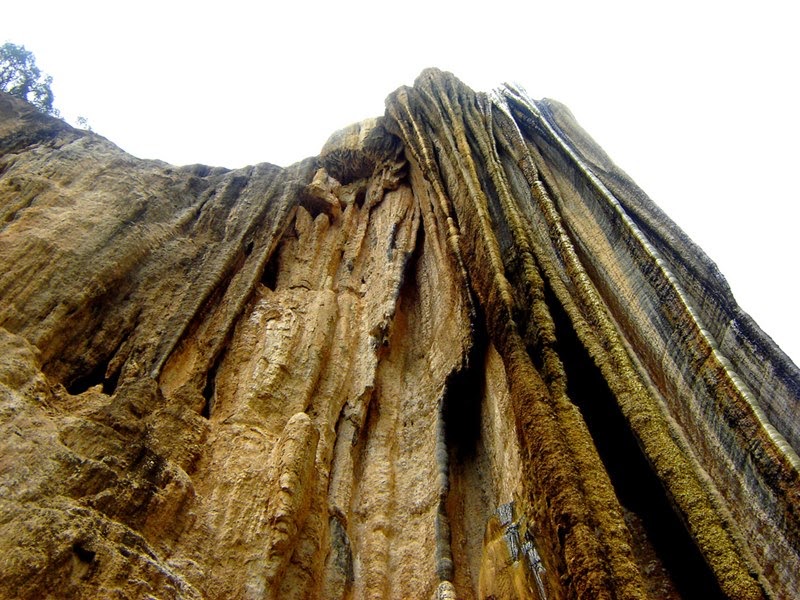
Image credit: lauraitooaxaca

Image credit: El mundo de Laura

Image credit: Kim F

Image credit: Rodrigo Soteres
Source — Wikipedia

No comments:
Post a Comment