Hutt Lagoon, on the coast of Western Australia, is known for its unusual pink water, which can shift between pale rose, red and orange depending on natural conditions. But the colour is only part of the story. The lagoon is also the site of a large commercial microalgae cultivation operation, where microscopic organisms are grown to produce beta-carotene, a pigment used in food colouring and other products.
 |
| Hutt Lagoon, also known as Pink Lake, is famous for its unusual pink waters along the coast of Western Australia. |
Dunaliella salina is a microscopic green alga which has adapted to very saline conditions and is largely responsible for the characteristic colour of the lagoon. Under intense sunlight and high-salinity conditions, the organism accumulates beta-carotene, a reddish-orange pigment that also occurs naturally in carrots and other vegetables. Large concentrations of these pigmented cells can give the water its characteristic pink and red appearance. The intensity varies with sunlight, cloud cover, water conditions and the season, so the lagoon does not always look the same. Tourism Western Australia explains the science behind the pink lakes.
What makes Hutt Lagoon particularly unusual is the commercial value of the same algae responsible for its colour. Artificial ponds have been established alongside the natural lagoon to cultivate Dunaliella salina for beta-carotene extraction. The Western Australian Government's wetland guide describes a 250-hectare cultivation system, while a separate scientific study published in 2015 reports a larger pond area. These figures reflect different documented descriptions and should not be treated as a confirmed measurement of the present-day operation. The government wetland guide explains the cultivation process and its products.
Beta-carotene is valuable because it is used as a natural colouring ingredient in foods and as a source of provitamin A in nutritional products. The human body can convert it into vitamin A, which plays an important role in normal vision and other functions. The commercial production at Hutt Lagoon therefore connects an unusual natural environment with the biotechnology and food industries.
The lagoon's extreme salinity also makes it scientifically interesting. Research published in Hydrobiologia in 1983 documented how the water level changes through the seasons, with winter rainfall filling parts of the basin and summer evaporation leaving a thick salt crust. A later scientific review explains that Dunaliella salina can survive beneath the salt layer during dry periods and return to the water when the lagoon floods again. The scientific review on Dunaliella in high-salt environments describes this remarkable adaptation.
NASA has also documented Hutt Lagoon from space. Its satellite imagery reveals the elongated lake, the surrounding coastal landscape and the distinctive cultivation ponds. NASA's Hutt Lagoon image provides a striking record of this unusual landscape.
First Image Credit: Flickr
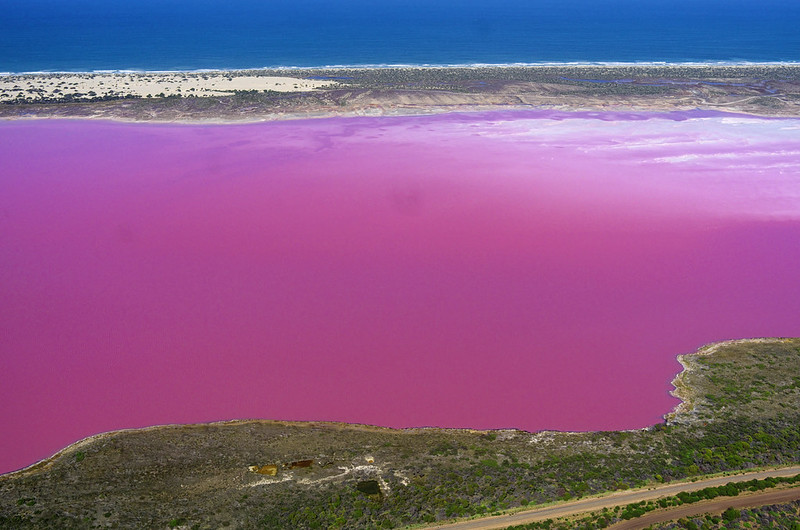 |
| The distinctive landscape of Hutt Lagoon, where salt-tolerant algae give the water its characteristic pink and reddish hues. |
 |
| The unusual pink waters of Hutt Lagoon, where salt-tolerant algae contribute to the lake's distinctive colour. |
 |
| The colourful waters of Hutt Lagoon, where salt-tolerant algae contribute to the lake's distinctive pink appearance. |
 |
| Hutt Lagoon is known for its unusual pink and reddish water, coloured by pigment-producing salt-tolerant algae. |
Conclusion
Hutt Lagoon is more than a naturally coloured salt lake. Its pink appearance reflects the survival of salt-tolerant algae, while the cultivation of Dunaliella salina gives the lagoon an important commercial role. The combination of unusual biology, extreme salinity and industrial algae production makes this corner of Western Australia a remarkable example of nature and biotechnology existing side by side.
1. Lake Amadeus: Australia's Vast Salt Lake near Uluru
URL: https://www.ritebook.in/2026/11/lake-amadeus-salt-lake-northern-territory.html
2. Maras Salt Mines: Peru's Ancient Salt Ponds
URL: https://www.ritebook.in/2026/11/maras-salt-mines-peru-ancient-salt-ponds.html
References & Sources
- Tourism Western Australia – The Amazing Pink Lakes
- Western Australian Government – Wetland Management Guide
- NASA – Hutt Lagoon, Australia
- Austrade – Exploring Australia
- Scientific review – The Ecology of Dunaliella in High-Salt Environments
- Scientific research – The Protozoa of a Western Australian Hypersaline Lagoon

No comments:
Post a Comment