Formed after the fall of a meteorite, Meteor Crater, or Barringer, is located about 69 kilometres east of the city of Flagstaff and near the town of Winslow, located in the northern Arizona desert, USA. Barringer Crater, or as it is called, Meteor Crater, originated about 50,000 years ago from a fall on Earth. The meteorite was a vessel of 300,000 tonnes and was flying at a speed of about 45,000 to 60,000 km/h.
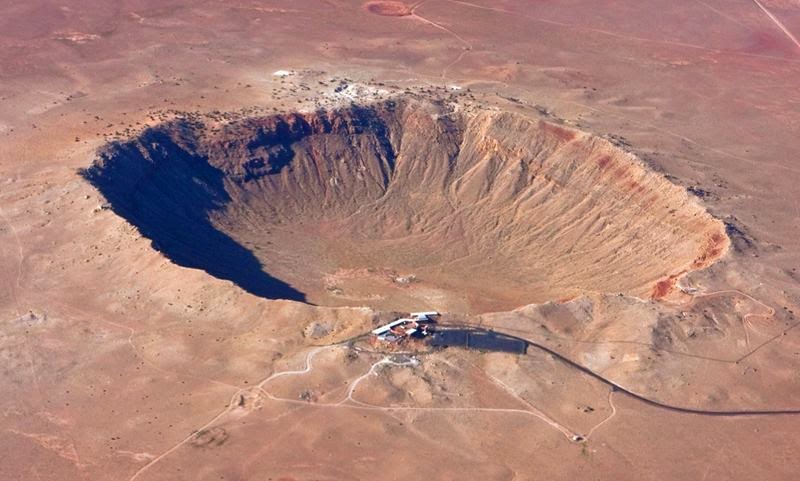
According to calculations, the explosion at the fall of the meteorite was three times more powerful than the Tunguska explosion, which can be compared with a thousand Hiroshimas. In the district of Arizona, craters were found with fragments of a nickel-iron meteorite. Some meteorites, such as the Tunguska meteorite, have left behind a crater. In contrast, Barringer Crater is perfectly preserved and has a shape similar to that of lunar craters. It has a considerable cavity width of 1200 metres and a depth of 200 metres.
Local Indian tribes have long been aware of the giant crater and have collected scattered metal fragments around it. There are numerous legends associated with this sacred place. Scientists became aware of the existence of the crater only in 1891. At first, it was thought that the crater was of volcanic origin. However, in 1902, it was suggested that it was a meteorite. Research involved mining engineer Daniel Moreau Barringer, who spent 26 years on the site but could not prove the meteoritic origin of the crater. Eugene Shoemaker found strong evidence of comets and meteorites.

Photo credit: Deborah Lee Soltesz
In Arizona, astronauts were trained who had to go to the moon. The local landscape is considered to be the most similar to the moon. Locals often talk about the appearance of UFOs in these places. Berنزhera crater is one of the most popular attractions in Arizona. This crater is not the largest meteorite that fell to Earth. In 1962, researchers discovered a meteor crater 241 km wide and 800 m deep on the island of Wilkes in Antarctica, near Hudson Bay in Canada.

Photo credit: NASA Blueshift
Meteorites rarely fall to the ground, but researchers still record a few cases. In 1908, over the Tunguska taiga, about 10 km from the surface of the Earth, the explosion occurred. Its sound was heard nearly 1,000 km away, and the trees were knocked down over an area of about 2,000 square kilometres. Some scientists think that an asteroid or comet fragment could have caused this colossal explosion.

Photo credit: Marcin Wichary
Some scholars suggest that this meteorite caused the mass death of the dinosaurs that occurred 65 million years ago. According to this theory, a giant piece of space pierced the Earth's atmosphere and reached the surface, leaving a crater 50 km deep and 200 km in diameter on the seafloor. Volcanic products and hot gases joined millions of tonnes of dust and rocks that were thrown into the air. Dust rose into the upper atmosphere and blocked the way of life-giving solar energy, causing impaired development of plants and reducing the amount of food, which caused the death of many animals, including dinosaurs. A large crater, recently found off the coast of Mexico, may confirm this theory.

Photo credit: aaronboyd2
Currently, the Arizona meteorite crater is a popular tourist destination, privately owned by the Barringer family. On the northern edge of the meteorite crater is a visitor centre, which presents interactive exhibits and where everyone discusses meteorites, asteroids, space, the solar system, and comets. We can see the 637-pound meteorite found in the area, as well as fragments of the meteorite crater found in Arizona; they can even touch it. Visitor Center, formerly known as the Museum, includes a theatre, gift shop, and observation point overlooking the inner edge of the crater, with daily excursions in astrogeology.

The tourist centre in Meteor Crater, Flagstaff, Arizona, exhibits the largest fragment discovered from the meteorite that formed Meteor Crater.
Photo credit: Wikipedia

Photo credit: Steve Jurvetson

Photo credit: Alex Healing

Photo credit: Jeff Kubina

Photo credit: Frank Pierson

Photo credit: Mike Sisk

No comments:
Post a Comment