Nyiragongo is one of the most active volcanoes on the planet; it is 2,000 metres high and has been little studied because the Democratic Republic of Congo, where it is located, has been constantly at war for the past 20 years. At the base of the volcano stretches the city of Goma, increasingly crowded with refugees escaping from rebel and government forces in the interior of the country. The diameter of the largest crater is about two kilometres wide, and in its very centre, a lake of hot lava is often formed, which this article is devoted to. For a long time, the hot Nyiragongo lava lake was the largest in the world.

Goma, with an estimated population of over 1 million people crammed together, has suffered the volcano's fury on many occasions. In 1977, the lava descended the mountain at over 90 kilometres per hour, killing several hundred people, although the flow hardened before reaching the main part of the city, and this lava lake was at its maximum depth ever recorded, 10,700 ft. In 2002, the volcano spewed more than 15 mi, well over 100 metres, of lava in central Goma, destroying 14,000 homes, burying many buildings and forcing 350,000 citizens to escape. © Photo by Olivier Grunewald
Active volcanoes of the world
© Photo by Olivier Grunewal
These two eruptions were mere "burps" compared to Nyiragongo's potential fury, however. According to Dario Tedesco, an Italian volcanologist who has devoted himself recently to studying the volcano to try to ascertain eruption cycles and warn authorities of a new disaster, Goma is the most dangerous city in the world.
In July 2010, Dario Tedesco went to Nyiragongo with a group of young scientists and a support team that included six guards armed with Kalashnikov rifles. His three-week assignment was equivalent to that of a doctor when evaluating a patient who had not had an exam for decades. The scientists wanted to conduct a full mountain survey, study its rocks, extract gas samples, and decipher its behavioural tendencies.
Active volcanoes of the world, Democratic Republic of the Congo
© Photo by Olivier Grunewal
After a full day of climbing, Tedesco reached the top of the volcano, on the barren, windswept edge. Its lake is one of the largest in the world. It is 200 metres wide and has a mesmerising kaleidoscopic surface. Black plates cut by orange fissures change their outline and shake with fury. The lake roars like a jet on takeoff and emits a dense white plume of dozens of lethal gases. The whole periodic table is revolving inside.
Tedesco felt like crossing a war zone after an extensive journey to hell's door to collect a sample from age zero. Before going down the mountain, he took one last look back as a way to register that unique image: "Stunning! Just amazing! I'll never see anything like it in my life again." These images are the record of this visit to the volcano's edge, which will eventually have an eruption capable of turning Gum into a new Pompeii.
© Photo by Olivier Grunewald
© Photo by Olivier Grunewald
© Photo by Olivier Grunewald
© Photo by Olivier Grunewald
© Photo by Olivier Grunewald
© Photo by Olivier Grunewald
© Photo by Olivier Grunewald
© Photo by Olivier Grunewald
© Photo by Olivier Grunewald
© Photo by Olivier Grunewald
© Photo by Olivier Grunewald
© Photo by Olivier Grunewald
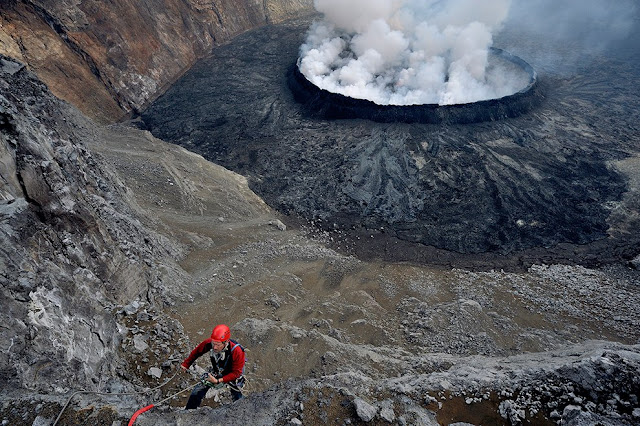 |
| In 1977 and destroying a good part of the city of Goma in 2002. The lava lake – which sits 400m deep inside the crater – is the biggest in the world. © Photo by Olivier Grunewald |
© Photo by Olivier Grunewald
© Photo by Olivier Grunewald
© Photo by Olivier Grunewald
© Photo by Olivier Grunewald
© Photo by Olivier Grunewald
© Photo by Olivier Grunewald
© Photo by Olivier Grunewald
© Photo by Olivier Grunewald
© Photo by Olivier Grunewald
© Photo by Olivier Grunewald
© Photo by Olivier Grunewald


No comments:
Post a Comment