In the heart of Rio de Janeiro, there’s a building that looks too grand to be a library. One of the city’s most remarkable cultural sites is the Real Gabinete Português de Leitura, known in English as the Royal Portuguese Reading Room. It features an ornate stone façade, a soaring interior, carved details and rows of ancient books. The institution, on Rua Luís de Camões in central Rio, is much more than an impressive historic building. It bears witness to the long-standing cultural connection between Portugal and Brazil and contains an incredible collection of Portuguese literature.
 |
| The historic Real Gabinete Português de Leitura in central Rio de Janeiro. |
A Library Born from Rio’s Portuguese Community
The story of the Real Gabinete Português de Leitura begins in 1837, when Portuguese immigrants in Rio de Janeiro founded the institution as the Gabinete Português de Leitura. Its original purpose was straightforward but important: to provide Portuguese books and promote education, reading and culture among the Portuguese community living in Brazil.
As the collection expanded, the institution needed a permanent building large enough to accommodate its growing library. The present building eventually became the answer to that problem. Construction began in 1880, during a ceremony that Emperor Pedro II presided over. The institution later became a public library in 1900. In 1906, it received the title “Real” from King Carlos I of Portugal, which gave the organisation the name it is known by today.
Real Gabinete Português de Leitura: Inside Rio’s Royal Portuguese Reading Room
 |
| Rio’s famous Royal Portuguese Reading Room is known for its magnificent architecture. |
A Striking Example of Neo-Manueline Architecture
The building was designed by Portuguese architect Rafael da Silva e Castro in the Neo-Manueline style, a 19th-century revival style based on the Manueline style of architecture associated with Portugal's Age of Discoveries. It is marked by elaborate decoration, references to the sea, natural forms and richly carved details.
The association with Portugal is very deliberate. Inspiration for the design came from famous Portuguese monuments like the Jerónimos Monastery in Lisbon. The designers wanted the building to convey Portuguese history and cultural identity, not just to be an attractive library.
The façade is made of Lioz limestone brought from Portugal. The exterior is adorned with sculptures and medallions. Historical figures depicted include those related to Portuguese literature and maritime exploration, such as Luís de Camões, Pedro Álvares Cabral and the Infante Dom Henrique.
 |
| The spectacular interior of Rio’s historic Portuguese reading room. |
The Famous Interior
If the exterior catches your attention, the interior is what makes the building truly unforgettable. The main reading room rises dramatically upward, surrounded by wooden bookshelves and galleries filled with books. Under the impressive roof structure hangs a large central chandelier, and natural light streams in through the upper windows, illuminating the room.
The result is a cross between a traditional European library and a historic cathedral. It’s not difficult to understand why the institution itself calls the Real Gabinete “a cathedral of Portuguese culture". The design was not simply decorative. Considerable attention was also given to the interior fittings, including columns, galleries and bookshelves designed to accommodate the growing collection.
 |
| Tall wooden bookshelves surround the main reading room. |
A Remarkable Collection of Portuguese Literature
Behind the spectacular architecture is an equally important collection. The Real Gabinete houses an extensive collection of Portuguese-language books, including rare works, manuscripts and historical collections. Over the decades, its holdings grew not only by purchase but also by major donations and private collections.
A fascinating example is the library of Brazilian writer and journalist João do Rio. Research published by SciELO documents how his personal collection eventually became part of the holdings of the Real Gabinete, adding one more layer to the institution’s literary history.
The library is of special importance due to this combination of Portuguese and Brazilian cultural history. It is not merely a collection of old books; It is a record of the intellectual relationship between two countries united by language, literature and centuries of shared history.
 |
| An elaborate ceiling adds to the grandeur of the historic library. |
Why the Royal Portuguese Reading Room Matters
The Real Gabinete Português de Leitura is special because its beauty and its historical purpose are inseparable. The building was created at a time when Portuguese immigrants in Brazil wanted a lasting cultural institution to preserve their language and literary heritage. Its Neo-Manueline architecture also served that mission by adding a distinctly Portuguese visual identity to the core of Rio de Janeiro.
Today, it still serves as a library and cultural institution. The official Real Gabinete website provides information about its collections, research activities, cultural events and visits. It is located at Rua Luís de Camões 30, Centro, Rio de Janeiro.
 |
| Centuries of Portuguese literature are preserved inside the library. |
Real Gabinete Português de Leitura: A Hidden Literary Gem in Rio de Janeiro
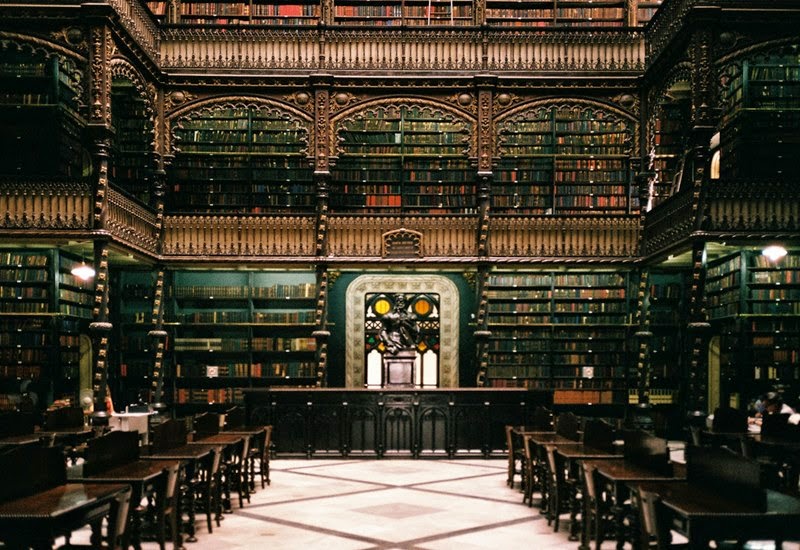 |
| The building showcases an impressive Neo-Manueline architectural style. |
Royal Portuguese Reading Room: Inside Rio’s Magnificent Historic Library
 |
| The ornate limestone façade reflects Portugal’s architectural heritage. |
Real Gabinete Português de Leitura: A Cathedral of Portuguese Culture
 |
| The grand reading room features towering shelves and historic details. |
Real Gabinete Português de Leitura: A Portuguese Treasure in Brazil
 |
| The entrance to one of Rio de Janeiro’s most remarkable historic libraries. |
Conclusion
The Real Gabinete Português de Leitura is one of those places where the building is as important as what it contains. Its towering bookshelves, historic architecture and extraordinary Portuguese collection make it a fascinating place to visit for anyone interested in literature, architecture or unusual places.
Founded in 1837 by Portuguese immigrants as a reading institution, it has survived for almost two centuries and become one of Rio de Janeiro’s most distinctive cultural landmarks. Today, entering the Royal Portuguese Reading Room feels like stepping into a little piece of Portugal in the middle of Brazil.

Thats a lot of trees. Tell me some are in hemp.......
ReplyDelete