On the rugged Oregon Coast, there is a natural formation that looks almost impossible. Thor’s Well appears to swallow seawater from the Pacific Ocean, then suddenly send it rushing back into the air. The dramatic hole sits on the rocky shoreline of Cape Perpetua, near Yachats, where powerful waves constantly reshape the basalt coast.
 |
| Thor’s Well sits among the rugged rocks of Oregon’s Pacific coastline. |
At first glance, Thor’s Well can look like a bottomless hole in the ocean. It is not. The formation is a natural sea cave in the coastal rock, and the waves passing through it create a spectacular appearance. When the tide and ocean conditions are right, seawater surges into the opening, rises dramatically, and spills over the edges before draining away again.
Where Is Thor’s Well?
Thor’s Well is located in the Cape Perpetua Scenic Area on the central Oregon Coast, about two miles south of Yachats in Lincoln County. The site is part of the Siuslaw National Forest, which protects a large area of coastal habitat, forest, trails, and rocky shoreline. Cape Perpetua itself is an impressive headland rising about 800 feet above the Pacific Ocean. It is one of the most dramatic viewpoints along the Oregon Coast and provides a spectacular setting for several unusual coastal formations, including Thor’s Well, Spouting Horn, and Devil’s Churn.
Cape Perpetua and the Oregon Coast
The landscape around Thor’s Well is very different from a typical sandy beach. The land seems to meet the ocean head-on in a rough area with dark basalt rock, steep cliffs, forested hills, tide pools, and crashing Pacific waves. The geology of the area goes back millions of years. Oregon's Department of Geology and Mineral Industries explains that ancient volcanic activity helped create the basaltic rocks and coastal headlands found in this part of Oregon.
 |
| Waves surge around Thor’s Well along the rocky Cape Perpetua shoreline. |
How Was Thor’s Well Formed?
Thor’s Well was not carved into the coast by a single dramatic event. It is generally understood to have developed through wave erosion. Over a long period, waves attacked weaknesses in the basalt shoreline and gradually enlarged natural cracks and openings. A sea cave formed in the rock, and eventually part of its roof collapsed. The result was the unusual bowl-like opening that visitors see today. The nearby city of Yachats describes Thor’s Well as a collapsed sea cave, while the Oregon Encyclopedia identifies Thor’s Well as one of several eroded fissures in the intertidal basalt around Cape Perpetua.
Why Does the Water Shoot Into the Air?
The strange effect is caused by the movement of the ocean. As waves approach the rocky shore, water is pushed into the openings and passages beneath the formation. When a larger wave arrives, the pressure forces seawater upward through the opening. The water may splash high above the rock before falling back toward the ocean. A few seconds later, the water drains away, creating the famous illusion that the Pacific is disappearing into the ground. That repeating movement is what provides Thor’s Well its almost unnatural appearance.
 |
| Pacific seawater pours into the natural opening as waves reach the rocks. |
When Is the Best Time to See Thor’s Well?
Thor’s Well is most dramatic around high tide, when waves can surge strongly into the formation. Travel Oregon recommends viewing it within about an hour before or after high tide, when the water movement is most impressive. However, stronger waves do not simply mean a better experience. They also mean greater danger. At calmer times, visitors may see the opening more clearly, while larger waves can produce spectacular bursts of seawater. Conditions along this section of the coast can change quickly, so checking the tide and weather before visiting is important.
High Tide and Ocean Conditions
There is a natural temptation to walk closer to the edge for a better photograph. That is precisely what visitors should avoid. Thor’s Well is surrounded by uneven, wet basalt, and waves can reach farther than expected. The City of Yachats specifically warns that sneaker waves and large sprays can sweep people into the ocean. Travel Oregon also recommends keeping a safe distance and notes that Thor’s Well can be dangerous to view from the shoreline.
 |
| A powerful wave sends seawater upward from Thor’s Well. |
Is Thor’s Well Dangerous?
Yes. Thor’s Well is beautiful, but it should never be treated like an ordinary sightseeing spot. The area can be dangerous due to heavy surf, slippery rocks, shifting tides, and sudden sneaker waves. The safest place to observe the formation is from an official viewing point or another safe location, rather than trying to stand near the opening. You do not need to approach directly beside the well to appreciate it. From a safer distance, the waves and surrounding coastline still provide an impressive view.
Thor’s Well and Nearby Coastal Attractions
One advantage of visiting Cape Perpetua is that Thor’s Well is not the only unusual natural feature nearby.
Spouting Horn and Devil’s Churn
Spouting Horn is another dramatic formation where waves force seawater through an opening in the rock. Devil’s Churn, meanwhile, is a narrow rocky inlet where waves rush into a channel and collide with the surrounding cliffs. Both are part of the same remarkable coastal landscape around Cape Perpetua. The area also has an extensive trail network. The U.S. Forest Service lists a 26-mile trail system within the Cape Perpetua Scenic Area, giving visitors opportunities to explore the forests and coastline beyond Thor’s Well itself.
Why Is Thor’s Well So Famous?
Thor’s Well has become one of the most recognisable natural attractions on the Oregon Coast for its extraordinary appearance. Photographs often make it look as though a giant hole has been punched into the Pacific Ocean. But the reality is even more remarkable. There is no need for a mysterious underground world or a supernatural explanation. The formation is a striking example of how water, rock, time, and erosion can create something that looks almost impossible. The surrounding Cape Perpetua landscape enhances the experience. Ancient volcanic rocks, forested slopes, cliffs, tide pools, and the open Pacific all come together in one small stretch of coastline.
 |
| High tide brings waves close to the opening of Thor’s Well. |
 |
| Pacific waves crash against the basalt rocks surrounding Thor’s Well. |
 |
| The rugged basalt coastline gives Thor’s Well its dramatic setting. |
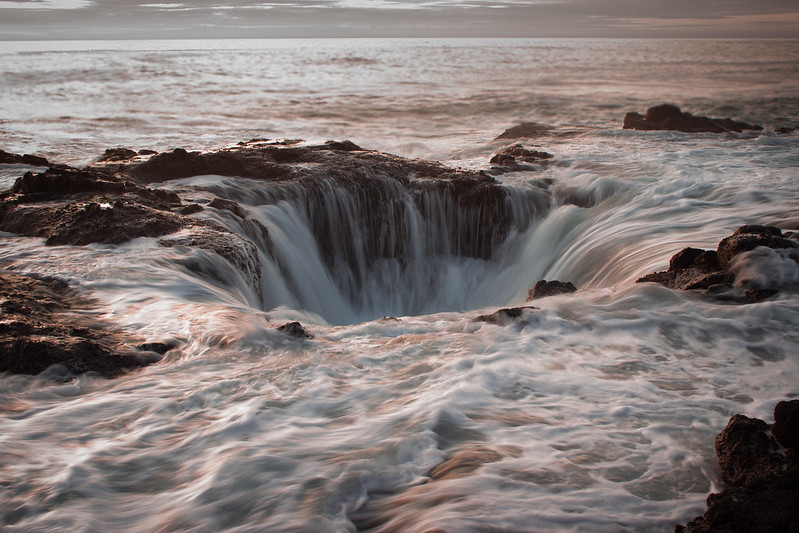 |
| From the shoreline, Thor’s Well appears to open directly into the Pacific Ocean. |
 |
| Incoming waves force seawater upward through the natural opening. |
Conclusion
Thor’s Well, Oregon, is one of those natural places that seem almost unreal when you first see it. Water appears to pour into the earth, disappear, and then burst upward again as the Pacific waves move through the rocky formation. Yet its real story is not supernatural. Thor’s Well was developed through the long interaction between waves and basalt rock, creating a collapsed sea-cave formation unlike anything most visitors have seen before. Located within the beautiful Cape Perpetua Scenic Area, Thor’s Well is best experienced as part of the wider Oregon Coast landscape. Just remember that its dramatic appearance comes with real ocean hazards. Keep a safe distance, respect the waves, and let the Pacific do the spectacular work.
You may like these. ›››››››
- The Willamette Meteorite → Secrets of North America’s Largest Space Rock
- Patomskiy Crater → The Mysterious Stone Cone Hidden in Siberia
- Río de la Plata → Where the Paraná and Uruguay Rivers Meet
- Sigiriya → Sri Lanka’s Ancient Rock Fortress
- Kayakoy → Turkey Ghost Town
References & Sources
- U.S. Forest Service — Cape Perpetua Scenic Area
- Oregon Encyclopedia — Cape Perpetua
- Oregon Department of Geology and Mineral Industries — Oregon: A Geologic History
- City of Yachats — Thor’s Well
- Travel Oregon — Cape Perpetua

No comments:
Post a Comment