High above a gorge in the Bavarian Alps sits a castle so theatrical it looks like it was sketched by a set designer rather than an architect. In a way, it was. Neuschwanstein Castle, tucked into the hills near the town of Füssen in southern Germany, has become one of the most photographed buildings on the planet — and the man who built it intended almost none of that fame.
 |
| Neuschwanstein Castle rises above the Bavarian landscape near Hohenschwangau. |
A King Who Wanted to Disappear
Neuschwanstein was the private retreat of King Ludwig II of Bavaria, a monarch far more interested in music, myth, and solitude than in ruling. Construction began in 1869, and Ludwig invested heavily in the project, financing much of it from his private funds and treating it less like a royal residence and more like a stage set for the operas of Richard Wagner, whose work he idolised. The rooms inside are covered in murals depicting swan knights, holy grail legends, and Germanic sagas — the whole building reads like a love letter to Wagner's music dramas.
The irony is striking. Ludwig built the castle to get away from public life. Today, about 1.4 million people visit Neuschwanstein each year, making it one of the most visited palaces in Europe. He also never saw it completed. Ludwig died in 1886 under mysterious circumstances at Lake Starnberg, just weeks after being declared unfit to rule, and only a fraction of the planned interior had been finished by then. Seven weeks after Ludwig II’s death in 1886, Neuschwanstein was opened to the public. The Bavarian government opened the castle to paying visitors, partly to help recoup the enormous debt Ludwig had run up building it.
What the Name Actually Means
"Neuschwanstein" translates roughly as "New Swan Stone", a nod to the swan symbolism found throughout Ludwig's favourite Wagner opera, Lohengrin. The name wasn't even used during Ludwig's lifetime — he called it New Hohenschwangau Castle, after the older, yellow-painted palace where he spent much of his childhood, which still stands in the valley just below.
 |
| Neuschwanstein, known as the Swan Castle, overlooks the mountain landscape of Bavaria. |
Inside the Castle: Grandeur Frozen Mid-Build
Of the more than 200 rooms originally planned, only about a third were ever completed, but the finished spaces are dense with detail. The Throne Hall is the most striking — a Byzantine-style chamber with a mosaic floor made of over two million stones, gilded arches, and a painted dome meant to evoke heaven, though the throne itself was never actually installed. The Singers' Hall, modelled loosely on the medieval hall of Wartburg Castle, was designed for musical performances and reflects Ludwig II's fascination with medieval legends and Wagnerian opera.
Structurally, the castle is a curious hybrid. Behind its mediaeval-looking towers are a steel skeleton and amenities that were advanced for the 1880s — running water on every floor, central heating, and even a telephone line. It looked backward toward legend while quietly being one of the more technologically advanced buildings of its era.
 |
| Schloss Neuschwanstein is one of Germany’s most famous historicist castles. |
Why It Feels So Familiar
Neuschwanstein's silhouette has arguably shaped more castle imagery than any other building in the world. Walt Disney's Imagineers were drawn to its towers and setting when designing Sleeping Beauty Castle for Disneyland, cementing the "fairy-tale castle" look in the popular imagination decades before most people had ever heard of Ludwig II or Bvaria.
Visiting Today
The castle can only be seen on a guided tour, and access is tightly controlled — tickets are sold for specific entry times, and they routinely sell out in the summer season. The official ticket office recommends booking online in advance rather than relying on same-day tickets at the counter, since long queues and sellouts are common in peak months (hohenschwangau.de). Photography inside the rooms isn't permitted, largely to protect the murals and furnishings. Most visitors combine the trip with nearby Hohenschwangau Castle, Ludwig's boyhood home, and Marienbrücke, the bridge overlooking the gorge that provides the classic postcard view of Neuschwanstein's towers.
 |
| The fairy-tale towers of Neuschwanstein stand above the forested hills of southwest Bavaria. |
FAQs
Is Neuschwanstein Castle actually a medieval castle?
No. Despite its Gothic and Romanesque styling, it dates entirely from the 19th century and was never intended for defence — it's a Romanticist fantasy building rather than a genuine medieval fortress.
Can you go inside without a guided tour?
No, entry to Neuschwanstein is only possible as part of a timed guided tour, and tickets should be booked ahead through the official ticket shop.
How long does the tour take?
The standard guided tour runs about 30 minutes and covers roughly 14 rooms.
Was the castle ever finished?
Not fully. Only around a third of the originally planned rooms were completed before Ludwig II's death in 1886.
 |
| Neuschwanstein combines Romanesque, Gothic and Byzantine-inspired architectural elements. |
 |
| Fairy-Tale Cinderella Castle Neuschwanstein |
 |
| Neuschwanstein Castle occupies a dramatic hilltop setting near Hohenschwangau. |
 |
| King Ludwig II commissioned Neuschwanstein as his extraordinary private retreat. |
 |
| The castle’s dramatic mountain setting adds to the fairy-tale character of Neuschwanstein. |
 |
| Neuschwanstein stands dramatically above the surrounding forests and Alpine landscape. |
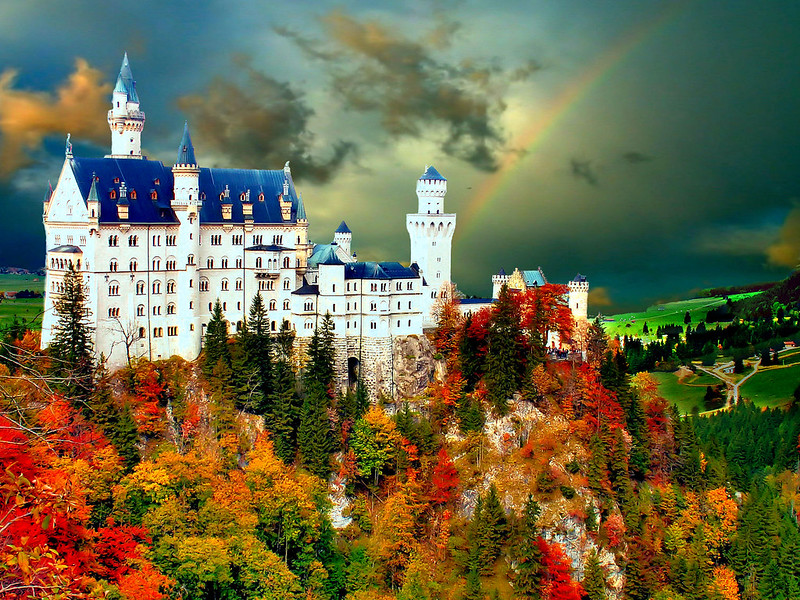 |
| The spectacular setting of Neuschwanstein adds to its famous fairy-tale appearance. |
Conclusion
Neuschwanstein Castle endures as one of the strangest success stories in architecture: a private fantasy, built by a king who wanted to be left alone, that ended up becoming a global symbol of what a castle is "supposed" to look like. It was never finished, never properly lived in, and never meant for the crowds that now climb the hill to see it — yet that unfinished, almost theatrical quality is precisely what makes it so compelling more than a century later.
YOU MAY LIKE THESE: >>>
- Frankenstein Castle – Mühltal, Germany
- Predjama Castle: Slovenia’s Castle Built Into a Cave
- Incredible Abandoned Places Where Time Has Left Its Mark
References & Sources:
No comments:
Post a Comment