The
Roman Walls of Lugo surround the historic centre of the Galician city of Lugo, in the province of the same name in Spain. The walls have also held Spanish
monument status (Bien de Interés Cultural) since 1921. It is a wall that completely preserves the old part of the
city and serves as a ride for tourists and locals. The ancient Roman town of Lucus Augusti was founded by Paulo Fabius Maximus on behalf of Emperor Augustus in 13 BC, with the aim of uniting the northwest of the Iberian Peninsula with the Roman Empire. This town was first a Roman camp that evolved into a city equipped with walls, which have remained until today with very few reforms and changes.
The entire length of
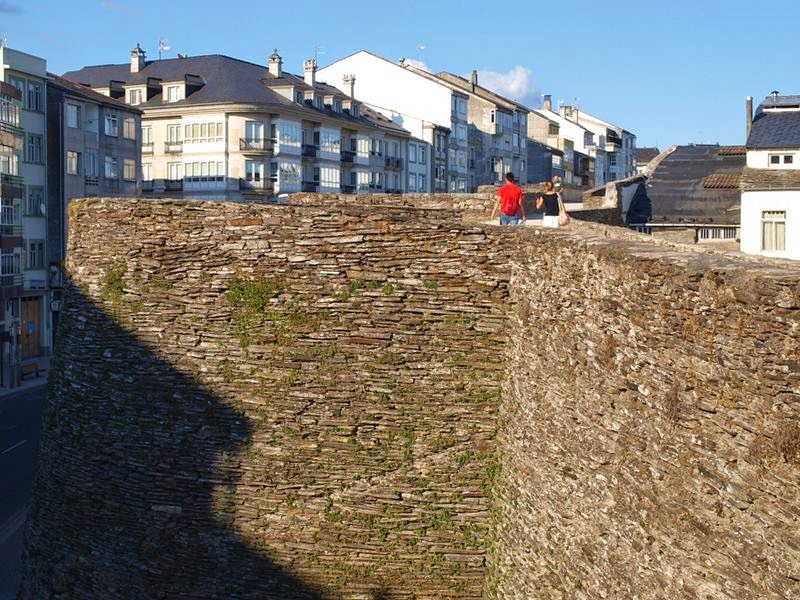
the walls is around 2,120 metres, enclosing an area of 34.4 hectares, with a width of around 4.2 metres and a height that varies between 8 and 12 metres. The impressive structure of this wall is lined with semi-circular towers, 46 of which have remained intact, while the other 39 are damaged in some way. The 10 gates (five dating to Roman times and five added after 1853 to accommodate the expanding town population) that exist in the wall serve as a link and provide accessibility between the new and historical parts inside the walls. It is one of the best-preserved Roman monuments; it is the only Roman wall entirely preserved. The material used for its construction is essentially the board and, to a lesser extent, the granite masonry. Today, the
Roman wall surrounds the historic centre of the city. This wall is completely passable, making it a beautiful walk for Lugo and tourists, who can use a map to explore the city. Originally built as a separation and defence, the wall has become an integrating element between the ancient and historic Roman Lucus and its surrounding area. The Roman Walls of Lugo were declared a World Heritage Site by UNESCO in 2000 as "the finest example of late Roman fortifications in western Europe" and have been twinned since the day of October 6, 2007, with the Great Wall of China, Qinhuangdao.




No comments:
Post a Comment